Thursday, 26 September 2013

RESEARCH: Copyright Clearance

XL Recordings,
One Codrington Mews,
London, W11 2EH


Re:  City And Islington Sixth Form Media Studies Music Video Project

Dear Sir or Madam:

I am an A2 Media Studies student putting together a Music Video for a coursework project .

We understand that you are the owner of the copyright in the musical composition “Neptune Estate' By your artist King Krule and want to include the song in the music video.  We want to use the entire song as the backing music for the video.

Since we are on a limited budget and distribution of the music video will be only to students and the administration of our school, we are hoping that you will allow us this use without any charge.

Your signature below, under “confirmed by,” will indicate that you will agree to permit this use without payment of a fee.  Please let us know if you have any questions concerning this license.  Also would you please let us know as soon as possible if this song cannot be licensed so that artistic changes may be made in the songs to be included in the production.

Thank you for your help with this matter and we look forward to hearing from you.

Very truly yours,

Elizabeth Anibaba


REFLECTION: Technical Skills


Reflecting back on the AS year

In the As year I learned skills in film making and the basics of a music video
I learnt skills such as:

Making & Planning a swede and short film

Making storyboards

Making templates

Using Final Cut Pro to edit

Adding filters and transitions

Using a base track and soundtrack

Using garage band

I also learned the importance of marketing and synergy/convergence in the success of a film

Research: Carol Vernallis

Carol Vernallis who studied editing and camera work closely in music videos, observed that edits in music videos come much more frequently than in film, also "that the editing seems to have a rhythmic basis closely connected to the song."

Some of the main points of Vernallis's observations :

  • edits may be really obvious to draw attention to themselves
  • Jump cuts are often used
  • the camera may move in time with the music.

Lana Del Rey's music video for Video Games is an example of Vernallis's observation that edits may be really obvious to draw attention to themselves, because there are multiple editing techniques used such as filters, transitions etc. It also changes to different 'mini' videos in a fast pace.


Miley Cyrus's music video for Who Owns My Heart also illustrates Vernallis' observation that Jump Cuts are often used.


Wednesday, 25 September 2013

Research: Copyright clearance

Over the summer I was tasked to send out letters to record labels which were connected to the artists that I had an interest in, we did this to ask for copyright permission to therefore remake the song with our own music video idea's. I sent out three letters, the one below is one of them.


12th August 2013

Warner Music Group

Griffin House
161 Hammersmith Road
London W6 8BS

Dear Sir/Madam

I would like to request for Copyright Permission to use 'Give me Love' by Ed Sheeran.

I am a student of A Level Media Studies and for my Advanced Portfolio I will be working in a group to produce a promotional package for the release of a new album track. I would like to request permission to use the above track for this project.

The finished project will not be made avaliable publicly and will be used solely for coursework purposes. The holder of the original copyright will be fully acknowledged in the finished project.

If you do not hold the rights for this song I should be grateful if you forward this request to the appropriate person, or return it to me with the contact details in that I might approach the copyright holder directly.
Yours faithfully

 
Jordane Davis

jordanedavis@outlook.com

Tuesday, 24 September 2013

Research for Music Video: Viral videos

As discussed in class, a viral video is a piece of media which spreads through out the internet increasingly quickly, and is usually done so through social sites such as Facebook, Twitter and so forth. Here are two examples of viral videos, Gangnam Style and The Fox(more recent).


Gangnam Style is up until this day from it's upload date is currently one one BILLION+ views.


Research for Music Video: Review of student video


Weaknesses:
  • Certain shots handheld, therefore is shaky


Strengths:
  • Variety of shot types used
  • Speed and slow motion
  • Creative imagination in terms of lighting used
  • Flashing lights are very fitting with the song
  • Lyrics fit with 'running free' imagery

Evaluation

Firstly this music video can be seen as illustration of the lyrics, as according Goodwin it clearly demonstrates the meaning of the song. For example 'running free' is demonstrated by running in the woods, also 'I hunt for you with bloody feet across the hallow'd ground' can be seen in one shot where the singer walks barefoot in the beginning. Secondly this video also supports Vernallis theory as it uses many jump cuts, that aren't necessarily on the beat with a base track. Also there are obvious edits that manipulate the time as there are slow motion and fast paced shots, which is done to interest the audience visually with the help of this variety. Lastly, the idea of the 'male gaze' introduced by Mulvey can be seen here, however to a very small extent in comparison to a music video such as Blurred Lines by Robin Thicke

Monday, 23 September 2013

Research for music Video: Laura Mulvey's Theory

''In a world ordered by sexual imbalance, pleasure in looking has been split between active/male and passive/female. The determining male gaze projects it's fantasy onto the female figure which is styled accordingly.''

According to Laura Mulvey, the 'male gaze' becomes fundamental in some music videos. An example of a very recent music video, stating at 180million views is Robin Thicke - Blurred Lines

In this music video all females are dressed in the same outfits, which makes them seem equal to one another, alongside the fact that they are showing a lot of skin.
They are also constantly in the background and/or with the main singers to make them look better by dancing, or simply stand and be 'appealing to the eye of the audience' or also known as the 'male gaze'.

[RESEARCH] Andrew Goodwin's Theory

Songs don’t follow Todorov’s theory of the conventions of how a narrative is structured into different stages (normality, problem, resolution). Andrew Goodwin noticed this and felt that music videos would require their own type of structure.

Songs often use repetition in their choruses or lines; similarly music videos repeat a certain shot during these lines. As we become familiar with a certain genre we see that certain shots repeat in certain genres e.g. during a guitar solo in a rock song we get a long shot of the guitarist playing. This repetition is also very helpful when it comes to promoting the song as it can become stuck within the audience’s head.
Music videos often build to a climax before their closure to reflect the structure of the song and so the viewer is more likely to remember it before the video (often) fades away.


Goodwin proposed that there were three different types of relations between a song and the video:


  1. Illustration:
  2. Where the video tells the story of the lyrics, often dance is used to express the mood in the song. An example of such is One Direction's Best Song Ever. 


  3. Amplification:

  4. Where the video introduces new meanings to the song but does not contradict it, adding layers of meaning. An example of such is Katy Perry's Roar. The song is about relationships but the video focuses on Katy trying to survive in the forest which adds another meaning (independence) to the song.


  5. Disjuncture:
  6. Where the video makes little or no connection to the lyrics and sometimes even contradict itself. An example of such is Michael Jackson's Man in the Mirror. The song is about self-realisation but the video centres on radical world events.


[RESEARCH] Function of a Music Video

The most simplistic definition of a music video is:

A filmed performance of a recorded song, usually accompanied by dancing and visual images interpreting the lyrics.

The main purpose of a music video (although it does have many) is to promote the single, the album and the artist. To do this, a music video has to:

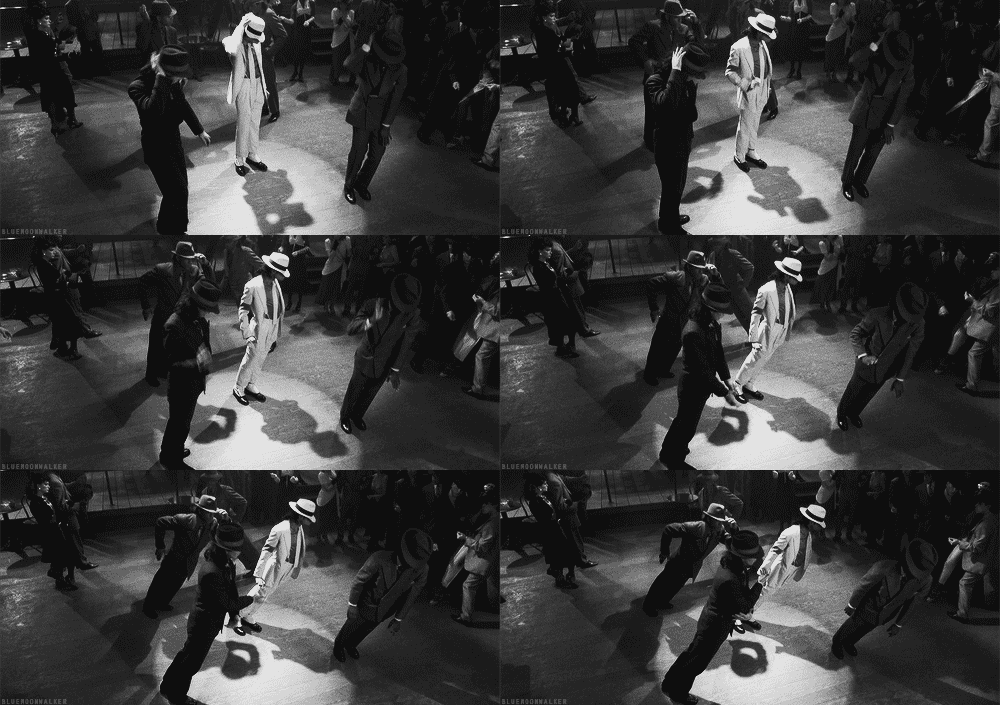
Michael Jackson's Smooth Criminal is a perfect example of a music video
that captures all three of these to promote the artist.
  • Make the video memorable so the audience can remember the song from the video.
  • Provide the viewer with a better understanding of the song so they can engage with it both visually and audibly (often achieved through performance or telling a "story").
  • Highlight the talents of the artist e.g. dancing, singing, performing and physical experience.

Enhanced by Zemanta

[RESEARCH] Copyright Clearance

Over the summer I was tasked with trying to obtain the copyright clearance for a song. or a selection of songs, from a British Artist/Group that I may wish to produce a video for in September. I chose to contact Bastille as I really enjoy their music and I have a few ideas floating around in my head of what the music video would look like. Here is a copy of the Copyright Clearance letter I wrote to them:


1 Yeatman Road
London
N6 4DS
25/07/2013

EMI Group Limited
27 Wright's Ln, London, W8 5SW

Dear Roger Faxon,

Request for Copyright Permission to use songs by Bastille

I am a student of A Level Media Studies and for my Advanced Portfolio I will be working in a group to produce a promotional package for the release of a new album track. I would like to request permission to use the tracks of the above band for this project.

The finished project will not be made available publicly and will be used solely for coursework purposes. The holder of the original copyright will be fully acknowledged in the finished project.

If you do not hold the rights for this song I should be grateful if you could forward this request to the appropriate person, or return it to me with the contact details in order that I might approach the copyright holder directly.

Yours faithfully,

Ali Jarjis,
ajarjis@hotmail.co.uk


[REFLECTING] Technical Skills Learnt

During my time spent in AS Media Studies, I picked up a variety of skills that I believe I can apply to the second year of Media Studies. They entail:

  • Using a camera - From being able to record with the camera, to being able to zoom and focus with it. I believe I can use the camera professionally which will reduce the amount of mistakes and allow me to produce my music video efficiently. Also with a knowledge of cinematography behind me I just what kind of shot/movement/angle would be appropriate for the particular scenario. 
  • Editing a video - My experience with Final Cut Pro has allowed me to learn all the in and outs of the system; from simply cutting a video to adding filters.
  • Editing sound - Along with editing I learnt how to place music and sound effects in a video and also altering it to my specific purposes.
  • Blogging - Having used Blogger for a year has given me the knowledge on how to use it expertly. So get ready for a flood of links, images, videos, Prezi's and more in upcoming posts.

[REFLECTING] Music Video Remake

At the end of AS Media, we had a chance to experiment on making a music video. In our (AS) groups we made a remake of the song Hey Ya by Outkast. Here is the final...ish product. (Embed video coming soon!) We also had to create a digi-pack for the album, here is what I was able to come up with:

Enhanced by Zemanta

Research for Music Video: Andrew Goodwin


Andrew Goodwin’s Theory
Dancing in the Distraction Factory

Goodwin had proposed that music videos contain a traditional narrative style and Todorov’s idea doesn’t apply to pop videos. That is because it relates more to movies as it presents an equilibrium/normality, disruption, recognition, and attempt to restore the disruption and finally come back to normality/equilibrium. This is obviously long-winded and usually would not fit into a music video of the average/traditional 3minute song, and therefore Goodwin proposes three types of music videos. They are:
1.     Illustration – the video tells the story and has a meaning
2.     Amplification – video presents new meanings and ideas that only add to the song and also relate to the lyrics
3.     Disjuncture – little or no connection between the lyrics and the music video
An example of Illustration would be ‘’Pap don’t preach’’ by Madonna. Amplification can be seen in (find example) and lastly Telephone by Lady Gaga is an example of Disjuncture due to the random plot of her going onto a ‘killing spree’ and committing murder when the lyrics have little connection to that.

Goodwin also proposes that Pop videos rely on repetition as the majority use the same images along with the chorus in the video. Therefore the audience may begin to associate certain mise-en-scene with a particular genre. An example of that may be Indie rock and three bands (Arctic Monkeys, The Killers and Franz Ferdinand) who all have similar conventions of camera movement, such as panning, also the instruments being the props and the stage as the location.

Arctic Monkeys - I bet You Look Good On The Dance Floor


The Killers - Somebody Told Me

Sunday, 22 September 2013

Research for Music Video: Carol Vernallis Theory


Carol Vernallis
Experiencing Music Video: Aesthetics and Cultural Context (2004)

Vernallis’s main statements are that edits are more frequent in music videos, the majority is disjuncture and involves base-track editing as the rhythm is usually connected to the song.
Some other points also involve editing such as CGI to draw attention, along with split screens and wipes. The base track is usually used to give the music video some composition and the camera can also move along with the music.

The examples for this are The Best Song (One Direction) because of disjuncture and the plot has little if any connection to the song. Another recent example can be We Can’t Stop (Miley Cyrus) that has an obvious base track editing especially in the beginning of the music video, as there are jump cuts only during certain beats of the song. On other example that has a clear master shot (base track) is Burn (Ellie Goulding), also similarly to We Can’t Stop the beginning along with the rest of the music video there are jump cuts on the beat of the song. There had also been obvious editing in all three music videos mentioned above, for instance Burn involved editing such as manipulation of time, meaning there’d been slow motion shots, usually of the singer. We Can’t Stop also includes slow motion during the swimming pool shots. Lastly The Best Song music video has different speeds of editing, fast paced to show many actions with the help of frequent jump cuts.


Reflecting back on the AS Year: Copyright Clearance


Research for Music Video: The function of a music video

The function of a music video is mainly for entertainment and aid explain the lyrics better (amplification/illustration) so the audience can engage and/or relate. It also contributes to the success of the artist, as it's made to sell their sound, style and allow them earn more money. They may also gain more publicity and become more famous, and the music video intends to do just that. In addition, the more bizarre the music video can be, the better it will be remembered by the fan-base and general audience, especially if it becomes viral. 

two examples of a viral music video is Psy - Gangnam Style and Lady Gaga - Telephone

A music video can also be used to market not only the singer/band but to advertise merchandise.


Reflecting back on the AS Year


This was our first attempt at a real digipak at the end of our AS Year. This was good practice because my editing skills are not exactly great and most of what I knew before I've forgotten, so this was a good reminder of what I can do and more.

I'm sure that in A2 when it comes to making my digipak my editing skills would be by far improved.

Saturday, 21 September 2013

Reflecting back on the AS Year: Technical skills


Technical skills that I have developed over the year:


  • Filters (editing)
  • Saturation
  • Improved editing in general
  • Master shot / Base track
  • Editing sound
  • Analysing/critiquing my own work to improve
  • Fade in/out
  • The importance of a tripod